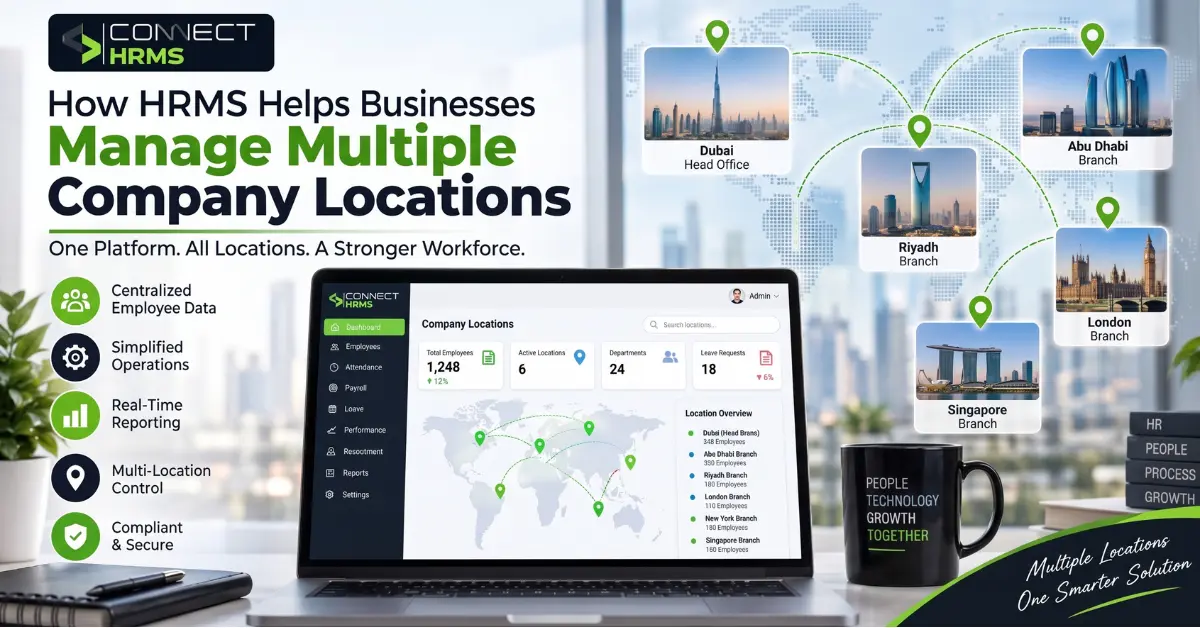
If you own a company that operates branches in Dubai, Abu Dhabi, Sharjah, or a combination of UAE cities, then you will be well aware of this problem. The first branch sends in attendance via WhatsApp messages. The second has a paper register lying on their counter. While by the time payroll comes around, HR is manually sewing things together from five separate sources.
The bottom line is that an HRMS would help your UAE company to manage multiple business locations by consolidating employee data for your organization in a single system, even as HR has control over branch wise attendance, shifts, leave, and payroll.
Why Managing Multiple Locations Is Challenging for UAE Businesses
Every extra branch adds friction, more than most owners expect when they open location number two. A few things that tend to go wrong:
- Employees working across different branches, sometimes covering shifts at more than one
- Different working schedules depending on the branch or department
- Attendance tracking that isn’t consistent from one location to the next
- Shift management handled manually, often on spreadsheets nobody fully trusts
- Leave requests and approvals stuck in email threads, or worse, on someone’s phone
- Payroll administration that eats up days instead of hours
- Employee records scattered across different systems, folders, or drawers
- HR managers who can’t see what’s actually happening at branches they’re not standing in
None of this is unusual. It’s just what happens once a business grows past one office, and most companies don’t fix it until it’s already a mess.
How HRMS Helps Manage Multiple Company Locations
1. Centralized Employee Database
Rather than having different spreadsheets for each branch, an HRMS holds all the information in one record for each employee, which includes his/her profile, department, position, branch assigned to, and related documents such as an Emirates ID copy and contracts.
For HR teams handling UAE-based employees across cities, this alone saves hours. No more digging through folders to confirm which branch someone belongs to or when their contract is up.
2. Branch-Wise Attendance and Shift Management
This is where HRMS software UAE businesses actually notice the difference day to day, not in the sales pitch, but in the daily grind of tracking who’s where. The system logs attendance by location, so HR can tell who clocked in at the Dubai branch versus the Abu Dhabi one instead of everything blurring into one confusing sheet.
It also handles:
- Shift management with multiple shift patterns running at once
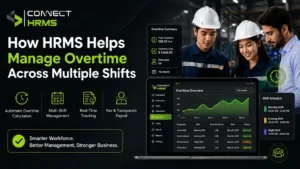
- Overtime management calculated automatically instead of by hand
- Location-based attendance visibility for managers overseeing more than one site
Connect HRMS is built around exactly this kind of branch-level clarity. Nothing slips through the cracks between locations, because there’s nowhere for it to slip to.
3. Payroll Management Across Multiple Locations
Payroll processing gets messy fast once branches start reporting numbers differently, one manager rounds hours, another doesn’t, and suddenly nothing matches. An HRMS pulls attendance, leave, and overtime straight from the system itself, so UAE payroll runs on actual records instead of guesswork.
For businesses juggling multiple branches, that means salaries calculated from real attendance data, overtime and leave already worked in, and branch-wise workforce costs you can check at a glance. It’s not really about legal complexity. It’s about having numbers you can actually trust when someone asks where the money’s going.
4. Leave and Approval Management
Employees shouldn’t have to wait for HR to physically show up at their branch just to sign off on a day away. That’s a lot of dead time for something that should take five minutes. With digital workflows:
- Staff submit leave requests online
- Managers approve from wherever they are
- Leave balances update automatically
- HR keeps central visibility across every branch, without chasing paperwork
5. Employee Self-Service for Distributed Teams
Employee self-service (ESS) matters even more once your team is scattered across different work locations. Instead of ringing HR for every small thing, employees can check their own information, pull up payslips, view leave balances, submit requests, and see where an approval stands without waiting around for a reply. Small stuff, but it adds up. It lightens HR’s load and gives employees a bit more control over their own stuff.
6. Workforce Analytics Across UAE Locations
Once everything sits in one place, comparing branches gets a lot easier. Management can pull up headcount, attendance patterns, overtime trends, leave usage, and workforce costs side by side for every location. Try doing that when each branch keeps its own spreadsheet, it’s practically impossible without someone spending a whole weekend on it.
HRMS for Multiple Locations vs. Manual HR Management
| Feature | Manual HR Management | HRMS |
| Employee records | Separate files per branch | Centralized |
| Branch management | Manual coordination | Digital, from one dashboard |
| Attendance | Spreadsheets or paper | Centralized tracking |
| Leave requests | Emails or paper forms | Digital workflow |
| Payroll data | Manually consolidated | Centralized, attendance-linked |
| Reporting | Time-consuming | Faster, ready when needed |
| HR visibility | Limited to one location | Across all locations |
Connect HRMS is built around exactly this kind of branch-level clarity. Nothing slips through the cracks between locations, because there’s nowhere for it to slip to.
Key Benefits of HRMS for UAE Multi-Location Businesses
- One centralized system instead of five disconnected ones
- Better visibility into what’s happening at each branch
- Less manual HR work, more time for actual HR strategy
- Faster approvals for leave and requests
- Cleaner, more reliable attendance records
- Simplified reporting when it’s time to review the business
- Stronger employee self-service experience
- Room to grow. A system that scales as you open new branches instead of buckling under the weight
What Should UAE Businesses Look for in Multi-Location HRMS Software?
If you’re comparing HR software UAE options, a few things matter more than shiny feature lists:
- Real multi-company and multi-company management support, no clunky workarounds
- Branch management that actually separates locations, rather than just tagging employees
- An employee database that’s easy to search and update on the fly
- Reliable attendance and shift management tools
- Leave management that cuts down the email back-and-forth
- Payroll functionality connected to attendance data
- Employee self-service people will actually use, not ignore
- Workforce reporting with useful comparisons, beyond raw numbers dumped on a page
- Mobile access for managers who aren’t glued to a desk all day
- Software built with UAE HR requirements in mind from the start
How Connect HRMS Supports Multi-Location Businesses in the UAE
Here’s where centralized, connected, automated, and scalable HR actually comes together. Connect HRMS keeps employee records centralized across every branch, links attendance, leave, and payroll data so numbers match up without manual reconciliation, automates repetitive tasks like leave approvals, and grows with you as you open new branches. No rebuild required when branch number six shows up. For UAE businesses managing different work locations, that adds up to less firefighting and more time spent on actual HR work.
Ready to bring your branches onto one system? Book a free demo today or reach out directly: call +971 457 13703 or email info@connecthrms.com, and someone from the team.
FAQs
What are the benefits of using an HRMS?
Less time on repetitive HR tasks. Accurate, centralized employee records. Real visibility into attendance, leave, and payroll instead of chasing spreadsheets around the office.
What are the 7 C’s of HR?
Usually listed as compliance, culture, communication, compensation, career development, coordination, and change management. Different lists tweak the order, but that’s the general set.
What are the top 5 HRMS systems?
Honestly, it depends on who you ask and where your business is based. Most lists mix global platforms with region-specific systems built around local labor laws.
What are the 7 main functions of HRM?
Recruitment, training and development, performance management, compensation and benefits, employee relations, compliance, and HR planning.
How does HRMS help with employee attendance across multiple locations?
It tracks attendance branch by branch in real time. HR sees location-specific data instead of stitching together separate systems by hand every time someone asks for a report.
Can HRMS manage payroll for different branches?
Yes. Payroll pulls directly from each branch’s attendance and leave records, so the numbers stay accurate without anyone manually consolidating them at month end.
How does HRMS improve HR management for remote and distributed teams?
HR keeps central visibility while employees handle routine tasks themselves through self-service. It works well once your team isn’t all sitting in the same building anymore.
What features should a multi-location business look for in HRMS software?
Multi-branch support, centralized records, attendance and shift tracking, payroll that’s actually integrated, and reporting that compares locations side by side.
What should UAE businesses look for in HRMS software?
Software built around UAE HR needs specifically, not a single-location system stretched to cover multiple branches. Solid attendance and payroll tools matter just as much.
Can an HRMS manage employees across multiple UAE branches?
Yes. That’s basically the whole point of multi-company HRMS software, every branch’s data stays centralized while each location is still tracked on its own.