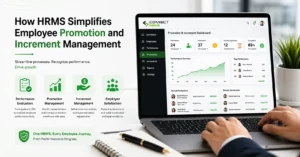
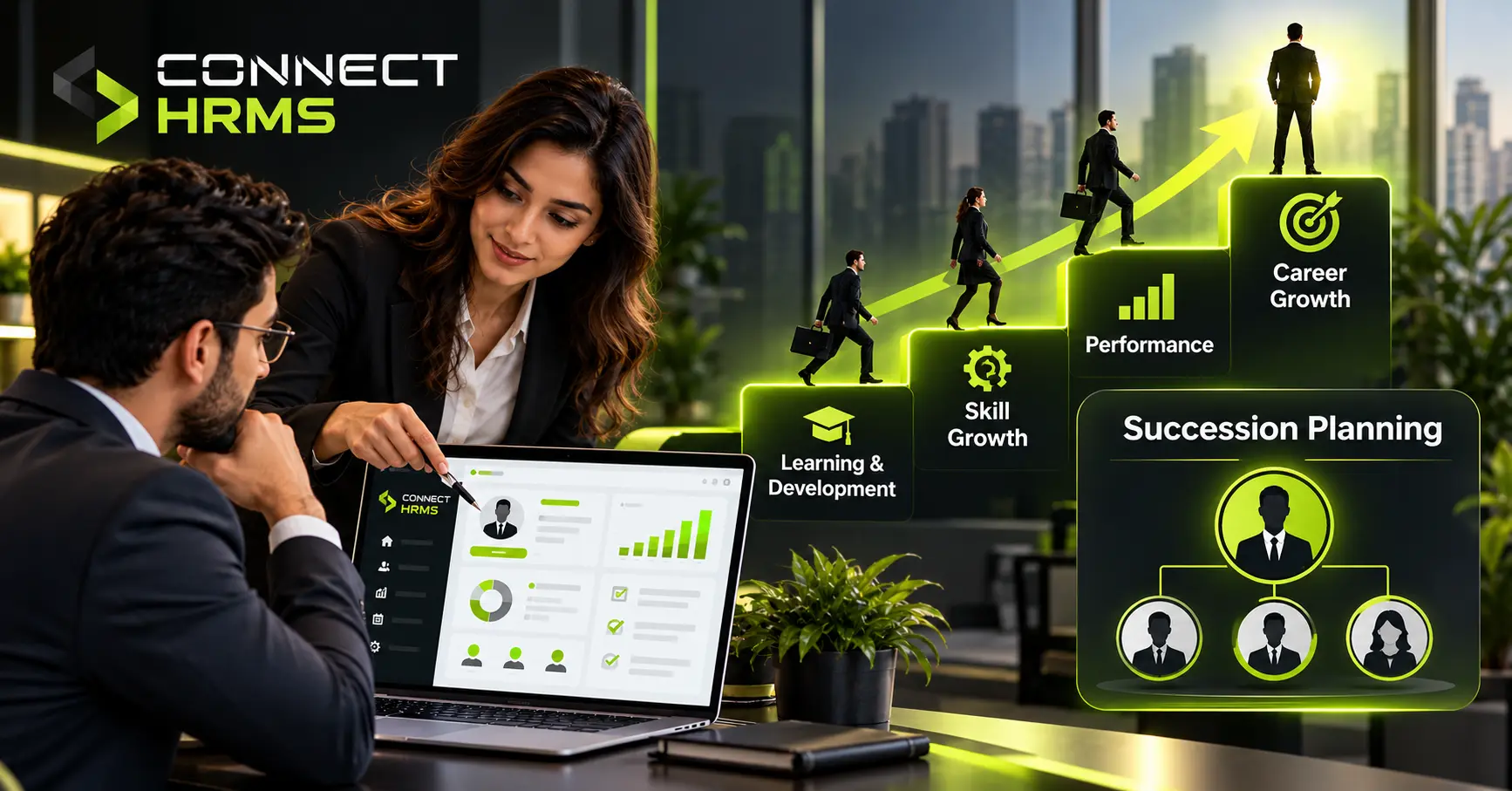
Most companies track employee growth across three or four disconnected places. A spreadsheet for skills, a folder for training certificates, someone’s memory for who’s actually ready for a promotion. Nothing talks to anything else, and that is precisely what makes an HRMS solution unique.
In a contemporary Human Resources Management System, all the performance, skills, and learning information is consolidated in one place so that it can be used for developing an employee’s career and succession planning. Not two separate projects. One connected system doing both jobs. At Connect HRMS, this is usually where the conversation starts when a growing company realizes spreadsheets just aren’t cutting it anymore.
How HRMS Supports Employee Career Development
Talent development doesn’t happen by accident, and it rarely happens well when it’s left entirely to memory or annual reviews nobody quite remembers a year later.
Create Clear Employee Career Paths
A good HRMS lays out exactly what’s needed to move forward. That includes:
- Current position and responsibilities
- Required competencies for the next level
- Skills needed for the target role
- Training requirements to close that gap
- Internal opportunities the employee might not even know exist
Instead of an employee guessing what promotion actually requires, it’s written down, visible, and tied to something real.
Identify Skills Gaps
Skill gap analysis works a lot better when performance and skills data actually lives in one system. Pull together:
- Skill assessments
- Performance reviews
- Certifications on file
- Outstanding training requirements
- Personal development goals
Put those side by side, and gaps that used to hide in scattered files suddenly become obvious.
Connect Employees With Learning Opportunities
The next step, after the gap is found, is determining what action should be taken. It is here that the connection between a Learning Management System LMS and an HRMS really comes into its own. Instead of HR sending out emails individually allocating each person’s training course, the system is capable of recognizing the necessary learning material in light of the gap discovered and helping to give the employee a way forward.
How HRMS Helps With Succession Planning
Succession planning is successful since HRMS makes it possible for organizations to identify critical positions, make an honest evaluation of their internal employees, monitor the progress of development of potential candidates, and develop them long before a vacancy arises.
The core pieces look like this:
- Identify critical positions across the organization
- Maintain detailed employee talent profiles
- Track high-potential employees as they develop
- Monitor leadership readiness against real criteria
- Record training and certifications as they’re completed
- Flag potential skill gaps before they become a problem
Build an Internal Leadership Pipeline
A leadership succession process can be stressful and costly because it involves waiting for a vital position to become available. This strategy has an opposite approach because an individual who will occupy the position is trained well ahead of time. This is done in anticipation of an employee leaving the organization.
Track Successor Readiness
Readiness doesn’t need to be complicated. Most HRMS platforms sort candidates into simple categories:
- Ready now
- Ready in 1 to 2 years
- Requires further development
That kind of clarity turns a vague, gut-feeling conversation into something HR and leadership can actually plan around.
Career Development vs Succession Planning: How HRMS Connects Both
| Area | Career Development | Succession Planning |
| Main focus | Employee growth | Organizational continuity |
| Primary goal | Develop skills and career paths | Prepare future successors |
| Data used | Skills, performance, training | Skills, performance, potential |
| Main users | Employees and managers | HR and leadership |
| Outcome | Career progression | Leadership pipeline |
These two things sound separate on paper, but in practice, one feeds the other. Employee development creates the actual talent pool that succession planning depends on. Without people actively growing their skills, there’s nobody ready to step into bigger roles when the time comes.
That’s really the whole point of connecting both inside one HRMS. The same skills data, the same performance history, the same training records, all reused for two different but related purposes instead of being tracked twice in two different systems.
Key HRMS Features That Support Both Functions
A handful of core HRMS capabilities do most of the work here:
- Employee skills inventory, keeping skills, qualifications, and certifications organized in one place
- Performance management, providing documented performance information to base development decisions on
- Learning and development tools, connecting identified skill gaps with relevant training
- A self-service portal, letting employees update their own certifications, skills, and career information
- Predictive analytics and talent analytics, helping HR teams read workforce capabilities and spot development needs early
- Succession planning tools, mapping critical positions against potential successors
Curious how this would actually work inside your organization? Connect HRMS can walk you through it. Call +971 457 13703 or +92 300 1110365, or email info@connecthrms.com.
Benefits of Using HRMS for Career Development and Succession Planning
Once it’s actually running, the practical difference tends to show up in a few consistent ways:
- Better visibility into employee skills across the whole organization
- More structured, less vague career paths
- Faster identification of skill gaps before they become urgent
- Improved employee engagement, since growth actually feels visible
- Stronger internal talent pipelines instead of starting from scratch each time
- Reduced dependence on external recruitment for leadership roles
- Better leadership continuity when someone unexpectedly leaves
- Centralized employee development records instead of five scattered files
How to Use HRMS for a Stronger Talent Pipeline
Building this out doesn’t need to be complicated. Five steps cover most of it.
- Build employee profiles. Collect skills, experience, certifications, and performance information in one place.
- Identify development gaps. Compare current capabilities against what future roles actually require.
- Create development plans. Assign training, mentoring, and development activities based on the gaps you found.
- Identify potential successors. Use structured performance and potential data rather than gut feeling alone.
- Monitor readiness. Keep tracking progress and update succession plans as people grow and roles change.
Frequently Asked Questions
How does HRMS support employee career development?
HRMS supports career development by centralizing skills, performance, and training data, then using it to build clear career paths and highlight development opportunities for each employee.
How does HRMS help with succession planning?
HRMS helps with succession planning by identifying critical roles, tracking high-potential employees, and monitoring readiness levels so organizations can prepare successors well before a role opens up.
What is the role of HRMS in talent management?
HRMS acts as the central system connecting skills, performance, learning, and career data, giving HR teams a complete view for talent management decisions across the organization.
How can HRMS identify employee skill gaps?
HRMS identifies skill gaps by comparing skill assessments, performance reviews, and certifications against the requirements of an employee’s current or target role.
How does HRMS help create career paths for employees?
HRMS creates career paths by mapping current roles to future positions, outlining the competencies, training, and internal opportunities needed to move forward.
Can HRMS identify high-potential employees?
Yes, HRMS can identify high-potential employees by tracking performance data, skill development, and readiness indicators over time, often using tools like a 9-box matrix.
How does HRMS improve succession planning?
HRMS improves succession planning by keeping talent profiles updated, tracking readiness for key roles, and giving HR a structured process instead of relying on informal judgment.
What are the benefits of using HRMS for employee development?
Benefits include better visibility into skills, faster gap identification, stronger internal talent pipelines, and centralized records that replace scattered spreadsheets and files.
Conclusion
Career development and succession planning are not two different topics, but two outcomes that come from the same information. An HR management system that measures skills, performance, and education gives the real foundation to both of these outcomes, rather than using a spreadsheet to manage development and another spreadsheet to plan for leadership roles.
If your organization is still doing this manually, then you might want to have a look at how it could work in reality. Connect HRMS will give you an idea of what it can do for your team. Contact us on +971 457 13703, +92 300 1110365, or info@connecthrms.com.